Ultherapy After Jaw or V-Line Surgery:
Timing and Planning
A dermatologist in Gangnam, Seoul explains when Ultherapy can be considered after jaw or V-line surgery. Ultherapy may be considered around 3–6 months after surgery, once most of the swelling has settled. The appropriate timing depends on your recovery and the findings of an in-person examination.
English consultations available
Why does the face look saggy after jaw or V-line surgery?
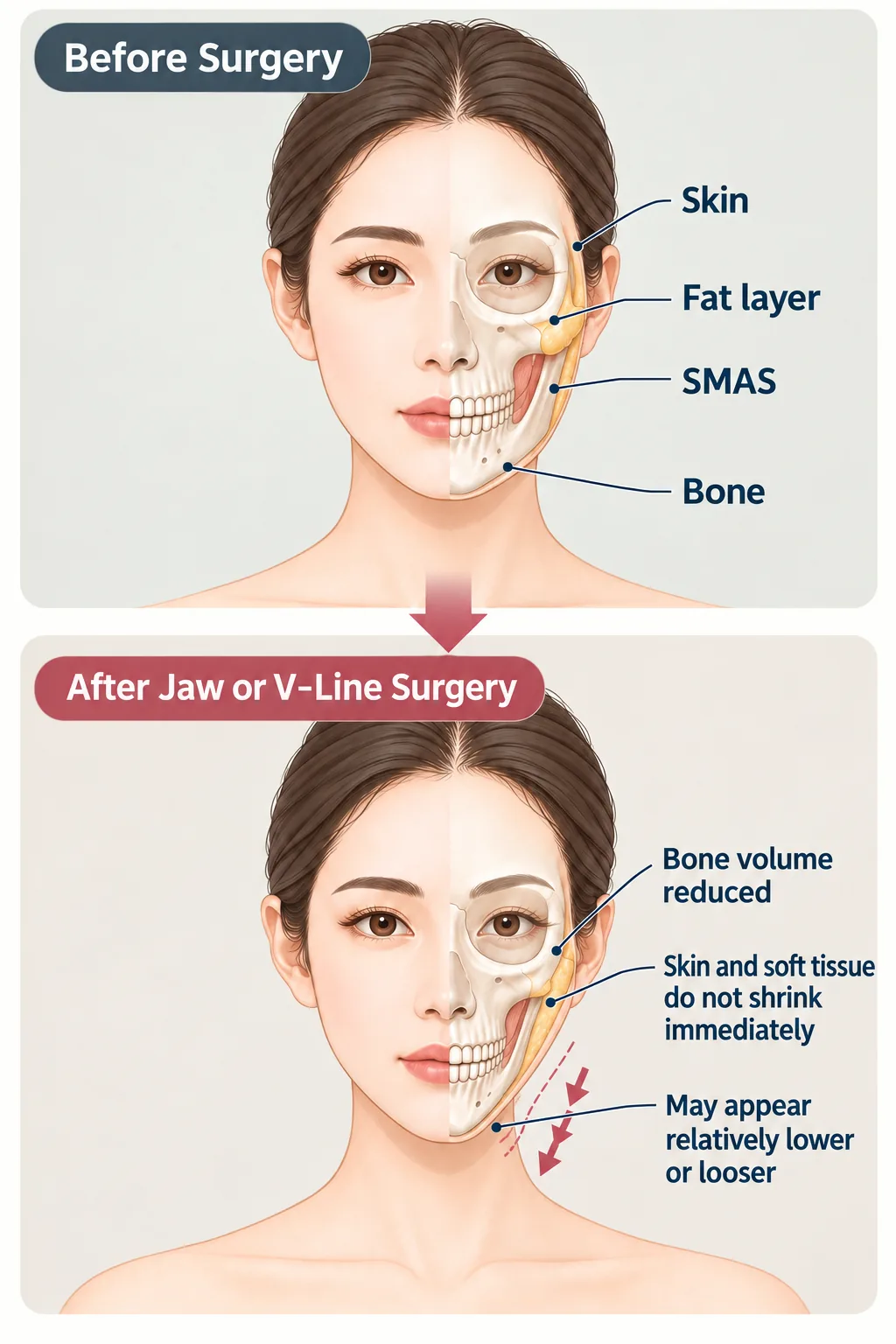
Jaw surgery (including double-jaw, or orthognathic, surgery) and V-line or facial contouring surgery reshape the bone. The skin and soft tissue that covered the bone do not shrink by the same amount.
- 1Less bone, but the same amount of soft tissue. The soft tissue that remains can look looser. Some people notice deeper nasolabial folds, jowls or a double chin.
- 2Supporting ligaments. In some cases the ligaments that hold the skin to the bone may be weakened during surgery.
- 3Your skin before surgery. If your skin was already losing firmness, sagging may be more noticeable.
When can you have Ultherapy after surgery?
Right after surgery, swelling makes it hard to tell whether the face is really sagging. We generally consider Ultherapy once most of the swelling has settled, often around 3–6 months after surgery.
These ranges are general guidance, not a rule. Being three months after surgery does not automatically mean you can have Ultherapy. We decide after an examination.
Is it swelling, sagging or volume?
Even at the same number of months after surgery, the right approach depends on your face. Instead of asking only whether you can have Ultherapy, we first look at what is causing the change.
Has the swelling settled?
Swelling can hide the real shape of the face for months.
Is it really sagging?
We examine the face to see whether skin and soft tissue have actually dropped.
Is the fullness caused by soft tissue volume?
A face can look heavy because of fat or soft tissue volume rather than sagging.
If your face did not become as small as you expected, for example when there is more soft tissue than bone, reducing volume may need to come before treating sagging. In that case we explain a different direction after the examination.
What we check before planning treatment
We do not apply a preset number of shots. Previous facial surgery is an important part of treatment planning.
Wherever you had your surgery, in Korea or overseas, we ask what surgery you had, whether metal plates or screws were used, and whether they have been removed.
| What we consider | Why it matters |
|---|---|
| Metal plates or screws | Energy-based lifting devices may deliver energy differently near metal, so we confirm this before treatment and adjust the energy and treatment range around it. |
| Extent of surgery | Where tissue was separated and where ligaments may have been weakened can change the depth and strength of energy that is needed. |
| Scars and sensitive areas | These are reflected in how we design the treatment. |
| Skin thickness and sagging | We design the jawline, cheeks and neck separately. Tips of 1.5, 3.0 or 4.5 mm are chosen according to skin thickness, so that energy reaches the SMAS (the fascial layer). |
The exact number of shots is decided after the swelling has settled, from an examination of where your face is actually sagging.
Ultherapy or a facelift?
If sagging is marked, a facelift may be considered, including for people in their 30s and 40s whose skin has lost a lot of firmness. A facelift does not stop natural aging afterwards, and areas that gradually sag again are often managed with Ultherapy.
Marked sagging
Tightens the supporting ligaments and fascia and removes excess skin. Considered when a more fundamental correction is needed.
Mild to moderate sagging
Tightens the SMAS without surgery and stimulates collagen. Considered for mild to moderate sagging and for follow-up care after surgery.
What to expect after Ultherapy
Swelling or tenderness after Ultherapy can last about 1–2 weeks. A face that has had surgery may recover differently depending on the surgery, so we review your surgery history and your current condition first.
If swelling lasts longer than expected, or looks clearly different on the left and right, tell us at your visit.
If you are visiting from abroad, tell us your travel dates and how many months it has been since your surgery, so we can tell you whether it is too early to be examined. For general information about Ultherapy PRIME, see Ultherapy PRIME in Gangnam, Seoul.
Consultation and treatment by a specialist physician
You can discuss your surgery history, your concerns and the treatment plan directly with your doctor. English consultations are available.
Common questions
Can I have Ultherapy within a month of surgery?
We do not recommend it. The first month is when swelling and bruising hide the facial line, so we cannot judge sagging yet. We usually wait until most of the swelling has settled.
My surgery was at another clinic or abroad. Can I still be treated?
Yes. At your consultation we ask what surgery you had, whether metal plates or screws were used, and whether they were removed, then plan the treatment from there.
How much does Ultherapy cost after jaw or V-line surgery?
One-on-one appointments · Your doctor personally handles every step, from consultation to treatment.
Questions about Ultherapy after jaw or V-line surgery?
Tell us what surgery you had and when. We can help you plan your visit.